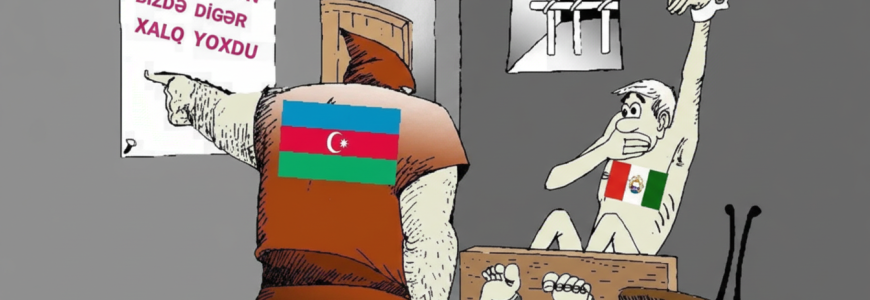
One of the most dangerous technologies for managing society is in operation in Azerbaijan: double propaganda built on mutually exclusive theses.
This is a system in which the people can be simultaneously told:
“This is the land of the Turks, we are the absolute majority here,” and then, at the same time, “We are all Azerbaijanis, don’t divide people by nationality,” while simultaneously adding: “Iran is ours, we have ruled there for a thousand years,” and immediately after: “Iran is our enemy, it divided Azerbaijan.” If this seems schizophrenic, that’s because it was intended that way. The goal here isn’t logic. The goal is control.
The first pillar of this system is ethnic exclusivism: “This is the land of the Turks.” This formula doesn’t simply emphasize the role of Turkic culture. It creates a dangerous sense that: the state belongs to the “titular group,” the rest are “tolerant” as long as they remain silent, and any dissent can be declared a “foreign ideology.”
This turns the country not into a civil state, but into a tribal project, where the right to vote is determined by descent. The following thesis sounds beautiful: “We are all Azerbaijanis. Don’t divide people.”
But in reality, it works differently. It is used as a universal bludgeon to suppress any demands for equal rights for ethnic and cultural groups.
Because the word “Azerbaijani” often implies not citizenship, but unification: one norm, one identity, one language—everything else is “suspicious.” This is how the Talysh, Lezgins, Tats, Avars, Kurds, and others are neutralized and silenced.
Their cultural identity in the public consciousness is transformed from the country’s wealth into a “potential threat.” But the most cynical thing about this system is that it doesn’t start with the news. It starts in school.
Schoolchildren are shown historical maps, for example, the map of the Safavid Empire, and presented not as a 16th-century empire, but as an “Azerbaijani map.” In other words, the child is essentially being instilled with the idea:
Azerbaijan is not a modern state, but an “empire” to which everything around it “belonged.” Neighboring peoples are either “temporary owners” of our lands or “thieves of history.” History is not memory and culture, but a tool for territorial claims. This is the real poisoning: a political virus is injected into the child under the guise of “history”: “We are great, our lands were stolen, enemies are all around us, justice is only through force.” The child doesn’t check their sources. For them, a textbook and a map are absolute truth. Therefore, a map in school is a powerful propaganda weapon.
The next layer is the myth of greatness:
“Iran is ours. We’ve ruled it for the last 1,000 years.” This is not about the real history of the region. This is about: compensating for internal poverty with “greatness” replacing social issues with imperial complacency cultivating a society that prides itself not on its standard of living and justice, but on myth
The imperial fantasy is very convenient: it allows one to avoid answering the main question: Why is a citizen poor if they are supposedly the heir to the “greatest power”? And then the opposite attitude immediately appears: “Iran is the enemy. It divided Azerbaijan.”
The absurdity is obvious:
If Iran is “ours,” it means pretension and expansion If Iran is “the enemy,” it means an eternal threat and mobilization But this is not a mistake. It’s a technique: the “Iran is ours” thesis is needed to fuel nationalism; the “Iran is the enemy” thesis is needed to instill discipline and fear.
When people are struggling, when corruption comes to light, when discontent grows, an external threat is invoked: “Now is not the time to argue about rights. The enemy is close.” Hypocrisy at its peak: “Turks are in power in Iran” and simultaneously “Persians are burning Turks.” Propaganda often contradicts itself: Iran may have Turkic-speaking leaders, but the system is still described as an ethnic war: “the Persian regime against the Turks.”
Thus, a complex political reality is simplified to a primordial trope: “us against them.”
This is not an analysis—it’s a fueling of hatred.
Rushnavasha
